



Rural septic service across British Columbia — find your town below
Search towns across Canada
Find yourSERVICE AREA
Acreage Septic British Columbia badge

Rural Septic Services Across British Columbia

Choose your town to contact the operator listed for your area. Confirm the service type, travel distance, timing and price directly by phone.

  • Operator details vary
  • Call for availability
  • Listed service-area contact
  • Confirm current pricing

Services to confirm

Common septic service requests

Operator capabilities differ. Confirm each required service directly with the listed operator.

Tank pumping

Confirm septic or holding-tank pump-out availability.

Confirm by phone

Inspections

Confirm real-estate or maintenance inspection availability.

Confirm by phone

Repairs

Describe the issue and confirm whether repair work is offered.

Confirm by phone

New systems

Confirm whether new or replacement systems are designed or installed.

Confirm by phone

How it works

From first call to booking

Step 1

Call or text

Share your location and describe the job you need.

Step 2

Confirm service and price

Ask whether the operator handles the job, travels to your location, and what the current price and timing are.

Step 3

Book directly

Book directly with the operator and confirm access instructions before the visit.

Service area

Find your town

Acreage Septic covers rural communities right across British Columbia, grouped by the operator who works each area. Acreage Septic covers rural British Columbia through 33 operator territories. This page lists 149 communities. Tap your town for local pricing and to call:

Cranbrook & area

View grouped service area

Houston & area

View grouped service area

Port Hardy & area

View grouped service area

Princeton & area

View grouped service area

Merritt & area

View grouped service area

Invermere & area

View grouped service area

Golden & area

View grouped service area

Kaslo & area

View grouped service area

Trail & area

View grouped service area

Williams Lake & area

View grouped service area

Creston & area

View grouped service area

Grand Forks & area

View grouped service area

Summerland & area

View grouped service area

Oak Bay & area

View grouped service area

Fraser Lake & area

View grouped service area

Prince Rupert & area

View grouped service area

Mackenzie & area

View grouped service area

Barriere & area

View grouped service area

Osoyoos & area

View grouped service area

Port Alberni & area

View grouped service area

Quesnel & area

View grouped service area

Lantzville & area

View grouped service area

Dawson Creek & area

View grouped service area

Fort St. John & area

View grouped service area

Revelstoke & area

View grouped service area

Salmon Arm & area

View grouped service area

Terrace & area

View grouped service area

Lake Country & area

View grouped service area

Powell River & area

View grouped service area

Hope & area

View grouped service area

Squamish & area

View grouped service area

Courtenay & area

View grouped service area

North Cowichan & area

View grouped service area
Useful septic article

Septic Systems in British Columbia: Maintenance, Inspections and Service

A practical guide for rural homeowners, acreage owners and cabin properties across British Columbia.

British Columbia septic systems often serve acreages, rural homes, lake properties and cabins where municipal sewer is not available. Whether a property uses a conventional tank and field, a more advanced treatment setup or a seasonal holding tank arrangement, the goal is the same: move wastewater safely, protect groundwater and keep the property functioning without costly surprises.

How septic systems work in British Columbia

The basic process is straightforward. Wastewater leaves the home, enters the septic tank, and separates into scum, liquid effluent and sludge. The liquid portion then moves to the next stage—often a distribution box and drain field—where soil finishes the treatment process. In British Columbia, slope, rainfall, seasonal use and site conditions can all affect how a system performs, especially on waterfront or heavily treed lots.

When to call for pumping, inspection or repair

Homeowners should call for service when they notice slow drains, sewage odours, soggy ground over the field, alarm warnings or sewage backing up indoors. Routine pumping, inspections and minor repairs usually cost far less than emergency repairs or drain field replacement.

Maintenance tips for British Columbia homeowners

  • Ask about pumping intervals based on tank size, occupancy and whether the property is used seasonally or year-round.
  • Keep vehicles, heavy equipment and new structures off the drain field area.
  • Direct roof runoff and surface water away from the tank and field, especially on sloped lots.
  • Before installation or replacement work, confirm local permit and provincial approval requirements.

Use the town list on this page to find the listed operator for your area, then confirm travel range, response time, pricing and the exact service you need. If you are buying or selling a rural property, it is also smart to ask about a septic inspection before the transaction closes.
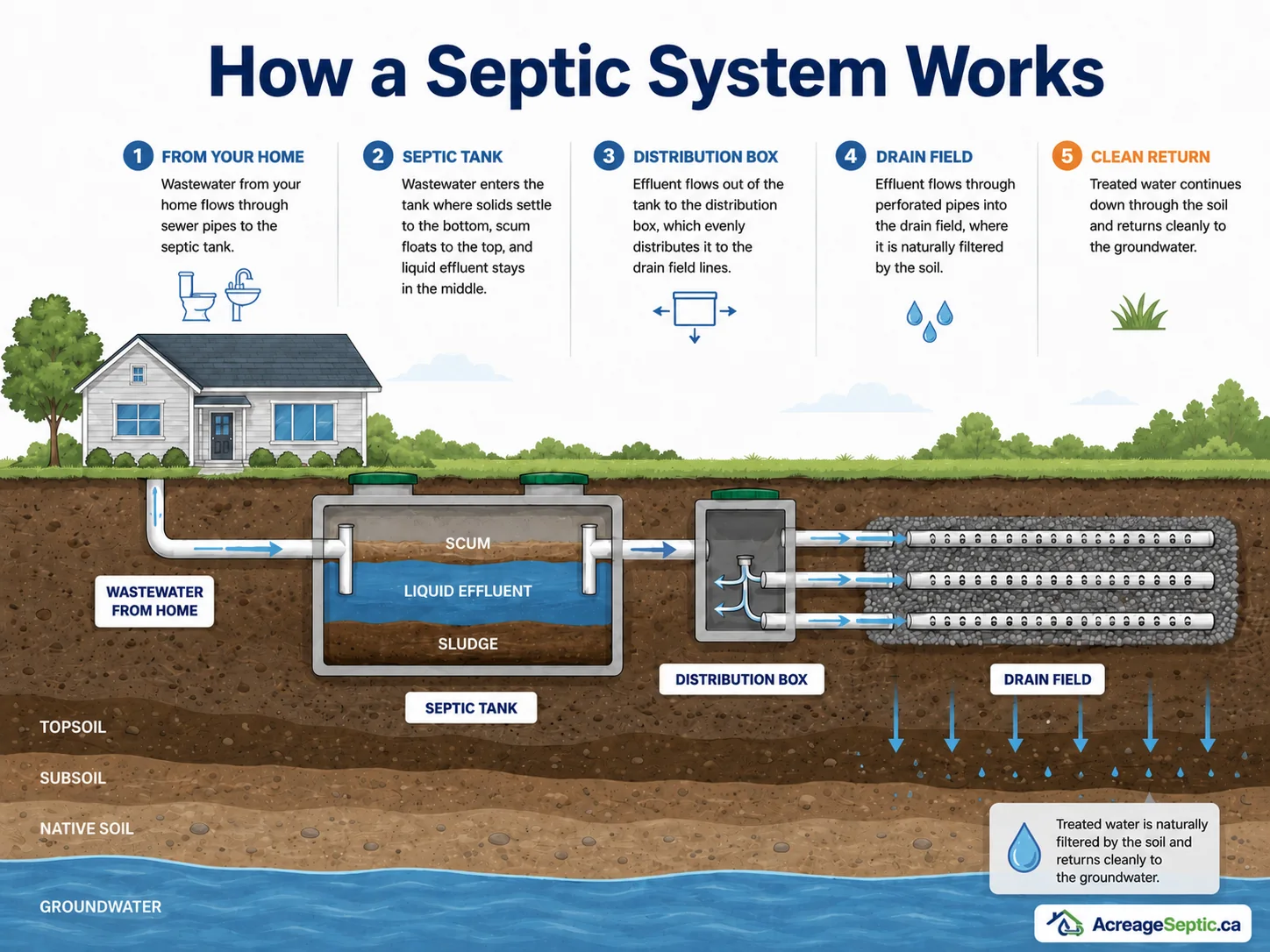

Diagram showing how wastewater flows from a home through a septic tank, distribution box and drain field.
A simple visual guide to the septic tank, distribution box and drain field.
Property note

Wet conditions, roots, slope and seasonal occupancy can all shorten the time between service visits on BC properties. Keeping access lids visible and the field area protected makes future service much easier.

Septic Systems in British Columbia: Maintenance, Inspections and Service
A second guide that supports homeowners researching service, inspections, warning signs or field protection.

What to confirm when you call

  • Does the operator service your exact community or acreage location?
  • Does the company handle the specific job you need: pumping, inspection, repair, installation, holding tank or emergency service?
  • What is the travel distance, scheduling window and current price?
  • If the system needs major work, what local approvals or permit steps should be checked first?

Reminder: this page is an educational starting point. For property-specific requirements, homeowners should confirm current municipal and provincial rules before installation, replacement or major system alterations.

Pumping

What to ask when booking a pump-out.

Inspections

Routine checks help catch issues earlier.

Drain Field Care

Protect the most important part of the system.

Verified customer feedback

Reviews for listed operators

AcreageSeptic should display only reviews matched to an operator’s exact business phone number.

View operator and verified reviews

Good to know

Septic questions, straight answers

How often should a septic tank be pumped in British Columbia?

Most rural households should pump every 2–3 years. Bigger families, smaller tanks or heavy water use can shorten that to 18–24 months. If you can't remember your last pump-out, it's time.

How much does septic pumping cost in rural British Columbia?

Pricing varies by operator, tank size, access and travel. Call the listed operator for a current quote.

What are the warning signs of a full tank?

Slow drains, gurgling toilets, sewage smell in the yard, or a strip of suspiciously green grass over the tank or field. Sewage backing up into the house means call right away.

Do you service acreages and cabins outside of town?

The listed operator is associated with this service-area cluster. Confirm travel limits and availability by phone.

Need help with a septic issue?

Call the listed operator to confirm the job type, travel distance, schedule and current price before booking.

📍 Find your town